Posts

Showing posts with the label food

2-YEAR EXCLUSIVE BUSH CAREER PROGRAM

Image
  Learn more at https://abt-edu.com 2 Years = 20 Certificates + 1 Year Work Placement   This is the ultimate BUSH CAREER kick-starter...With no prior knowledge or experience needed, this 2-YEAR EXCLUSIVE BUSH CAREER PROGRAM could help you take the biggest step in your life towards a successful career in the African bush... There are few global sectors as large, lucrative or resilient as the Field Guiding, Wildlife and Hospitality industry. An incredibly diverse sector that creates millions of job openings each year, offering career opportunities that are enjoyable, accessible and rewarding in the extreme. Lodges, reserves and operators throughout Southern Africa and Africa are constantly on the lookout for talented individuals and leadership figures to add to their ranks. More importantly, the wildlife and hospitality sector is known for its commitment to promoting from within, investing heavily in the career development of employees at all levels. Even from an entry-l...

The purple-crested turaco (Tauraco porphyreolophus) is a species of bird in the family Musophagidae.

Image
  Learn more at https:abt-edu.com The purple-crested turaco (Tauraco porphyreolophus) is a species of bird in the family Musophagidae. It clambers acrobatically through riverine woodland and savanna thickets. In flight it explodes from the canopy with distinctive deep red panels in the wings. It produces a distinctive croaking “khoh-khoh-khoh-khoh….” that gets progressively louder before suddenly stopping. The Purple-crested Turaco is a fruit-eater. Its glossy and colourful plumage makes this bird very attractive for humans. Turacos have been hunted in the past for their beautiful red flight feathers used as adornments by African people. Today, this species has adapted to suburban life, especially in Durban. The Purple-crested Turaco is frugivorous and feeds on fruits from numerous plant species. It forages in canopy, picking the fruits by perching at the end of the branches. This bird does not feed on the ground, except in captivity. The small fruits are swallowed whole, whe...

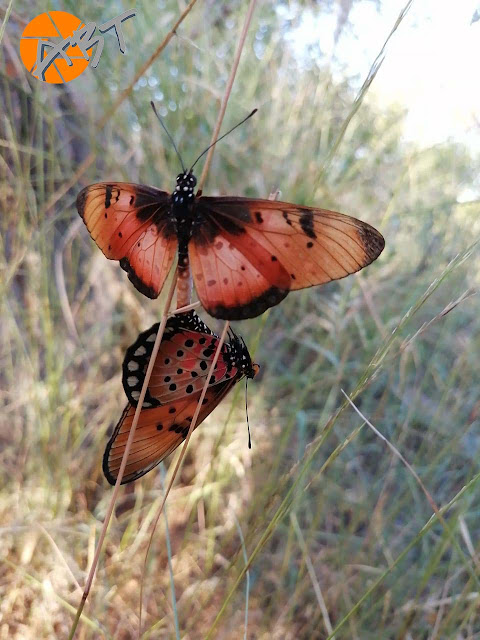
The Natal Acraea (Acraea natalica) is a butterfly of the Nymphalidae family.

Image
  Learn more at https://abt-edu.com ©Estian Kruger Butterflies have a Holo-metabolic lifecycle and belong to the Order Lepidoptera. They undergo complete physical changes, i.e. insects undergo four developmetal stages, the embryo, larva, pupa, and adult. This is a meduim sized butterfly with a wingspan of about 59mm. Males are pinkish red , females are brownish red. Their wings are spotted with black and with black bases. Adults are on wing year round, with a strong peak in late summer in southern Africa. v   What is the difference between a butterfly and a moth ?   Butterflies                                                                   ...

A Burchell's zebra ( Equus quagga burchellii), a subspecies of plains zebra.

Image
  Learn more at https://abt-edu.com AVERAGE LIFE SPAN IN THE WILD: 25 years No animal has a more distinctive coat than the zebra. Each animal's stripes are as unique as fingerprints—no two are exactly alike—although each of the three species has its own general pattern. Zebras are social animals that spend time in herds. They graze together, primarily on grass, and even groom one another. Plains zebras are the most common species. They live in small family groups consisting of a male (stallion), several females, and their young. These units may combine with others to form awe-inspiring herds thousands of head strong, but family members will remain close within the herd. Zebras must be constantly wary of lions and hyenas. A herd has many eyes alert to danger. If an animal is attacked, its family will come to its defense, circling the wounded zebra and attempting to drive off predators. Plains Zebra are much less numerous than they once were, because of human activities suc...

The Mopane tree and its importance #BotanyFriday

Image
Learn more at https://abt-edu.com Colophospermum mopane, commonly called mopane,mopani,balsam tree,butterfly tree,or turpentine tree, is a tree in the legume family (Fabaceae), that grows in the far   very hot northern parts of southern Africa. The tree only occurs in Africa and is the only species in genus Colophospermum. Its distinctive butterfly-shaped (bifoliate) leaf and thin seed pod make it easy to identify. In terms of human use it is, together with camel thorn and leadwood, one of the three regionally important firewood trees. Mopane wood is one of southern Africa's heaviest and is difficult to work because of its hardness.However, this also makes it termite resistant. For this reason it has long been used for building houses and fences, as railway sleepers and as pit props. The termite-resistance and rich, reddish colouring also make it popular for flooring. Outside Africa, mopane is gaining popularity as a heavy, decorative wood, its uses including aquarium ornaments, ...

The giant jewel beetle is a favourite protein-rich insect delicacy in many rural communities of Limpopo Province.#ConservationTuesday

Image
Learn more at https://abt-edu.com Their lazy nature makes them an easy catch, as they spend most of their time clinging to thorny bush trees. Adults feed on foliage (especially of Vachellia, Senegalia trees and Dichrostachys species) as well as nectar. Larvae are free-living root-feeders. Sternocera orissa displays sexual reproduction. Adult females are generally bigger than their male counterparts. Females lay eggs (during mid-December to late January) in bark crevices, and larvae tunnel into wood and plant stems. At times, eggs are laid into the soils or dropped onto the ground. Females have a single reproductive cycle annually. Adults are relatively short-lived, whereas the immature stages can take as long as 35 years to complete their development. Giant jewel beetles tend to be social and often semi-gregarious, occurring in small communities. No direct predators are known for Sternocera orissa. However, resource competition (i.e. for nectar and pollen) is common; since Vachellia ...

The African clawed frog (Xenopus laevis, also known as the xenopus, African clawed toad, African claw-toed frog or the platanna)

Image
Learn more at https://abt-edu.com These “flat frogs” live in natural water-bodies, but you might see them in your garden pond. They also don’t mind living in the local sewerage works. At the end of the rainy season, they bury themselves under wet mud, where they hibernate until the next rains. Common platannas feed in the water on any living creatures they can overpower. Their prey includes frogs and tadpoles (including their own kind), insects and other invertebrates (mosquito larvae are consumed by young frogs), small fish, young birds and mice that fall into the water. They even feed on carrion in the water. In the 1930s, it was discovered that a female common platanna would spawn if injected with the urine of a pregnant woman (the hormone chorionic gonadotropin being the active ingredient). In the 1940s and ‘50s, this was the only available pregnancy test and many hospitals around the world kept and bred platannas so that they could perform such tests. Contact us at info@africa...

The Impala Lily #BotanyFriday

Image
Learn more at https://abt-edu.com The impala lily is known in Africa and southern Africa as a source of fish poison and arrow poison. The poison is prepared from latex in the bark and fleshy parts of the trunk, but it is always used in combination with other poisons. Leaves and flowers are poisonous to goats and cattle, but the plants are sometimes heavily browsed and are not considered to be of much toxicological significance. Despite the toxicity, it is used in medicinal applications and in magic potions. Their striking forms and beautiful flowers borne in masses over a long period make them excellent garden and container plants. Impala Lily flowers mainly in July, but will also bloom as late as mid-September in places where it is cultivated. Flower size is about ± 5 cm across. Contact us at info@africanbushtraining.com

Humorous Elephant STEW FOR A CROWD #ABTRecipeFriday

Image
Learn at https://abt-edu.com INGREDIENTS 1 Elephant 2 Rabbits (optional) Salt and Pepper DIRECTIONS Cut elephant into bite size pieces. This should take about 2 months. Add enough brown gravy to cover. Cook over hot fire for 3 weeks. This will serve 3800 people. If more are expected, the two rabbits may be added, but do this only if necessary as most people do not like to find hare in their stew. HOWEVER AND EVEN BETTER, feast on the magnificance of these animals ALIVE and enjoy the wholesome feeling of being a healthy ambassador for wildlife conservation in Africa . Happy Friday  - and remember, keep your stomach's full good food and your minds busy with wildlife!

FIELD GUIDE/LODGE MANAGEMENT COMBO COURSE #CareerSaturday

Image
Learn more at https://abt-edu.com DURATION: 3 Months Full-time Students will get the once in a lifetime opportunity to gain knowledge and experience across ALL lodge departments and qualify themselves as all-rounder's when it comes to job-role suitability and adding value to possible future employment prospects. This course is for people serious about starting a career in the African Safari Lodge industry as it exposes you first-hand to the realities of   living and working on a game lodge…The experience and knowledge you will gain from this all-in-one course is priceless and the skills acquired will stand you in good stead for a lifetime career in the African Safari Lodge industry…   QUALIFICATIONS INCLUDED: FGASA Apprentice Field Guide (NQF2) & Game Lodge Management STUDENT FEE: R 87 000:00 INCLUDED: Meals, Accommodation, Study Material, Uniform Contribution, Membership-, Exam-, Assessment- & Moderation- Fees. Contact us at info@africanbushtraining.com

HOSPITALITY MANAGEMENT PROGRAM

Image
Learn more at https://abt-edu.com DURATION: 3 Months Full-time   The course centres around three primary topics of importance, which include an introduction to hospitality management, an overview of all the key operations in hospitality and the responsibilities to uphold industry standards.    This HOSPITALITY MANAGEMENT PROGRAM, offers a comprehensive introduction to this dynamic and diverse business sector.  The course is designed for those with a strong interest in hospitality management, though no specific experience. A series of eight detailed modules gradually introduces students to every important skill, trait and insight required to begin or advance an exciting career, followed by practical work experience in a typical bush camp and high profile guest lodge. QUALIFICATIONS INCLUDED: Lodge Leadership, Game Lodge Management, Accommodation Services, Professional Cookery & Kitchen Operations, Hospitality Reception, Food & Beverage Services, Ev...

Let's go Camping in The Kruger National Park #WildWednesday

Image
Learn more at https://abt-edu.com Tired of the hustle and bustle of the city? Get away for a day or two and experience Africa's  wildlife like never before ... Camping Trips often include watching the sunset , sitting by the fire and unwinding visits with friends or family. Here are a few simple tips to follow next time your in the Kruger : Take a camera. Always keep your permit in the car with you . Be careful of monkeys and baboons . Get up early and stay out late. Drive the dirt roads for less traffic. Look out for upset birds and monkeys. Dress for heat, even in winter. NEVER STOP LOOKING . Get two-way radios if with friends ! Walk around the camp perimeter at night. Be respectful of the animals. Have a cracking day ! Share , Share , Share....

Becoming a good Birder #ABTRecipeFriday

Image
Learn more at https://abt-edu.com Have good eyes and ears, and a good brain. At its most fundamental level, birding involves seeing and hearing birds, and then processing the visual and aural input to the birder’s brain. Start young. It is more difficult if you begin as an adult or even a late teenager. Don’t get cocky. Teen birders, who, despite brilliant sensory and neural apparatus, are eerily capable of mistaking a common Savannah Sparrow for a mega-rarity Baird’s Sparrow. Stay with it. The longer you bird, the better you learn. Know status and distribution. This information makes a huge difference in the bird identification process. Learn vocalizations of as much birds as you possibly can. Understand behavior. Recognizing behavioral clues is a key component of bird identification. Go naked! You don’t necessarily notice stuff when you’re birding with binoculars or any other equipment. Have fun. Birding doesn’t promise a cure for cancer. Birding doesn’t provide a clear path to world...

GAME LODGE MANAGEMENT COURSE (FULL- OR - PART TIME)

Image
Learn more at https://africanbushtraining.com Full-time Contact Training DURATION : 30-Days STUDENT FEE : R 35 000:00 INCLUDED : Meals, Accommodation, Study Material, Uniform Contribution, Membership-, Exam-, Assessment- & Moderation- Fees COURSE CREDITS : This course is accredited by TRIDEN Hospitality Staff Investment Projects and the ISCI (International Students Conservation Initiative) and is aligned with CATHSSETA requirements for the National Certificate. COURSE MODULES: Housekeeping Service Porter Service Table & Drinks Service Professional Cookery & Kitchen Operations Front-of-House operations (Reception) Preventative Maintenance Guest Relations & Customer Service Function Management & Coordination Lodge Leadership OR CHOOSE  I-LEARN Distance Learning & Full-time Contact Training DURATION & STUDENT FEES PHASE 1 : R 8 000:00 PHASE 2 : R 14 000:00 (10-Days Practical Contact Training) TOTAL :   R 22 000:00 IN...