Posts

Showing posts with the label impact

Take a look at the Winged Predatory Katydid (Clonia wahlbergi)

Image
  Learn more at https://abt-edu.com Katydids are identified by their long antennae that can grow up to two to three times the length of their body and is covered with sensory receptors to help find their way in the dark. They are notorious for their plant like appearance and for their ability to blend in with vegetation. The katydid gets its name from the way the male and female songs sound.   They create sounds by rubbing a scraper on one forewing against another forewing.   It has hearing organs located inside a slit on its front legs.   Male song organs are located on their front wings and females chirp in response to the males song that sounds like “katy did, Katy didn’t.”   The song is usually used for courtship during the late summer. Katydids have adapted and come up with ways to hide from their predators.   They have excellent camouflage capabilities and are able to pose like leaves and mimic other insects.   Their predators are bats, birds...
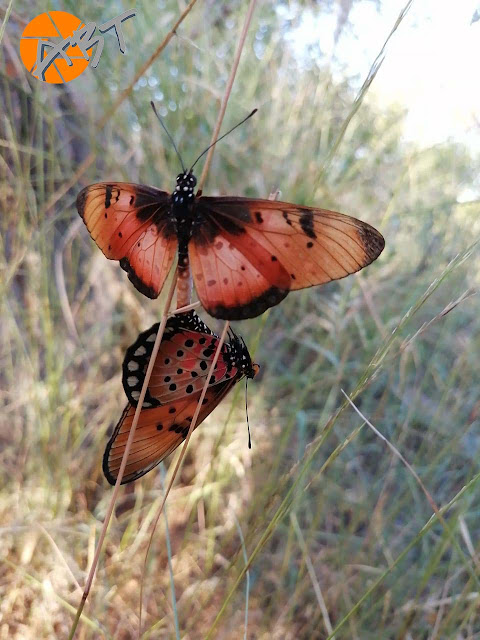
The Natal Acraea (Acraea natalica) is a butterfly of the Nymphalidae family.

Image
  Learn more at https://abt-edu.com ©Estian Kruger Butterflies have a Holo-metabolic lifecycle and belong to the Order Lepidoptera. They undergo complete physical changes, i.e. insects undergo four developmetal stages, the embryo, larva, pupa, and adult. This is a meduim sized butterfly with a wingspan of about 59mm. Males are pinkish red , females are brownish red. Their wings are spotted with black and with black bases. Adults are on wing year round, with a strong peak in late summer in southern Africa. v   What is the difference between a butterfly and a moth ?   Butterflies                                                                   ...

Argemone ochroleuca (Mexican Prickly Poppy) an invasive plant.

Image
  Learn more at www.abt-edu.com Invasive alien vegetation refers to plants brought to South Africa from other countries, both intentionally and unintentionally, that cause human, environmental or economic harm. Without natural enemies, these plants reproduce and spread rapidly, taking valuable water and space from our indigenous plants. This plant is native to Mexico and has also been introduced to many temperate and tropical regions of the world where is considered as an invasive weed. Commonly found as a weed of roadsides, mining dumps, rabbit warrens, recently cultivated paddocks, waste places, and over grazed pastures. It often occurs as dense stands in sandy stream beds and alluvial flats associated with intermittent inland streams. An extremely hardy pioneer plant, it is tolerant of drought and poor soil, often being the only cover on new road cuttings or verges. It has bright yellow latex. It is poisonous to grazing animals, and it is rarely eaten, but it has been used m...